If you are wondering if there are guidelines out there for an Ulcerative colitis diet you’ve come to the right place! We will go over the basics and even provide a 7- day meal plan for Ulcerative colitis. This blog was inspired by the amount of requests we have gotten for it after publishing our Ulcerative colitis food list.
First off, navigating what to eat when you have Ulcerative colitis can feel overwhelming. The internet is full of conflicting advice, fear-mongering food lists, and one-size-fits-all meal plans that don’t account for how different IBD is from person to person.
Speaking of personalized approaches, we are talking about things that are “IBD friendly” – meaning what’s been shown in research to reduce risk of flare & help induce remission.
However, this doesn’t mean these foods won’t trigger symptoms and doesn’t account for the fact that this might feel out of reach for some. If that’s the case, check out our Flare Guide + Ulcerative colitis Meal plan and book a session with us.
7-day meal plan for Ulcerative Colitis
While we would never encourage you to use the internet or a blog to take the place of having your own IBD dietitian giving you guidance, we wanted to provide a practical example of what integrating a colorful approach could look like. There is a high chance some things on here might not work for you or be accessible right now because this isn’t individualized guidance specific to you. If you need that please book a session.
We highly encourage you to download our free RAINBOW challenge as well which pairs nicely with this!
What this 7-day meal plan does differently is root every meal in an evidence-based framework: the IBD-Specific Food Guide Pyramid developed by researchers at Massachusetts General Hospital and Harvard Medical School, and interpreted here with guidance from The Crohn’s & Colitis Dietitians IBD-specialist registered dietitians.
The IBD Friendly Food Guide
The IBD Food Pyramid doesn’t tell you to eat perfectly — it gives you a flexible framework built on priorities. Fruits, vegetables, and leafy greens form the foundation. Resistant starches and legumes come next, followed by homemade meals, a variety of proteins, and finally, choosing the right fats. Each day in this plan reflects those priorities while keeping meals practical, delicious, and realistic for everyday life.
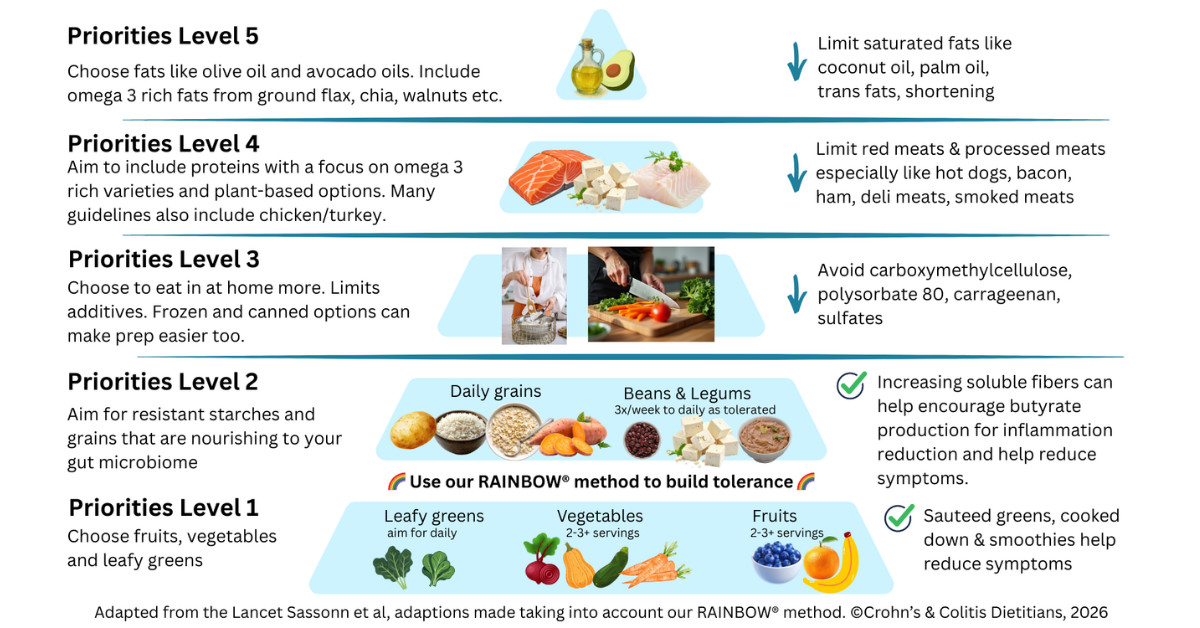
The IBD Food Pyramid doesn’t tell you to eat perfectly — it gives you a flexible framework built on priorities. Fruits, vegetables, and leafy greens form the foundation. Resistant starches and legumes come next, followed by homemade meals, a variety of proteins, and finally, choosing the right fats. Each day in this plan reflects those priorities while keeping meals practical, delicious, and realistic for everyday life.
One important principle from The Crohn’s & Colitis Dietitians guidance: this is not about restriction. Instead of eliminating foods you fear, the focus is on crowding in more of the right foods — more color, more variety, more whole ingredients. If a food on this plan triggers your symptoms, swap it for a better-tolerated alternative in the same food group, and introduce new foods slowly, in small amounts, to give your gut time to adapt.
Understanding the IBD Food Guide
Before diving into the meal plan, it’s worth understanding the five priorities that shape every day of eating in this guide:
Priority 1 — Fruits, Vegetables & Leafy Greens (eat the most)
The foundation of the pyramid. The research recommends a wide variety of colors daily — blueberries, raspberries, oranges, apples, bananas, squash, carrots, beets, lettuce, spinach, and kale. Notably, research suggests that IBD patients who consumed high-fiber foods including fruits and vegetables were 40% less likely to experience a flare compared to those who avoided them. If raw produce is hard to tolerate, cooking, blending, or pureeing makes these foods far more digestible without sacrificing their benefits.
Priority 2 — Resistant Starches & Legumes
Cooled or reheated potatoes, sweet potatoes, yams, parboiled white rice, and legumes like beans, lentils, chickpeas, and edamame. These foods feed beneficial gut bacteria and support a healthy microbiome. If large portions are difficult, start small — even 1/3 cup daily is a meaningful step. Mashing, pureeing, or using legume pastas and bean flours are all excellent preparation strategies.
Priority 3 — Homemade Meals (at least 5 days per week)
Eating homemade at least 5 days per week is explicitly recommended in the IBD pyramid. This isn’t about cooking elaborate meals — it’s about knowing what’s in your food. Processed foods, baked goods, and foods with additives and emulsifiers have been linked to worsening IBD symptoms. Simple, home-prepared meals from whole ingredients give you control and reduce your exposure to these compounds.
Priority 4 — Protein Variety
Fatty fish (salmon, herring, mackerel, sardines, trout, arctic char) are recommended 2–3 times per week or more for their omega-3 anti-inflammatory benefits. Nuts and seeds — or their butters if whole versions are hard to tolerate — are recommended 5 times per week. Tofu is a great way to bring in an easily tolerate legume that also has many gut health benefits. Red and processed meats should be limited.
Priority 5 — Healthy Fats (use sparingly but choose well)
Extra virgin olive oil is the preferred fat. Saturated fats should be limited, and trans fats (hard margarine, palm oil, shortening, commercially prepared baked goods) should be eliminated.
Every day of this 7-day plan is built around these five priorities. Each day’s meals are followed by a short IBD Pyramid alignment note so you can see exactly how each day connects to the framework.
Before You Start: 7-day Meal Plan for Ulcerative Colitis Tips
You might be wondering what if a food listed triggers me? This blog shouldn’t be used as a replacement for medical nutrition therapy with a dietitian. Since this isn’t customized advice or nutrition therapy, it’s just a starting point.
Keep in mind there are different types of triggers too- things that trigger symptoms and food patterns associated with inflammation and increased disease activity. To see our deep dive on the 3 main types of triggers, check out our YouTube below.
The Crohn’s & Colitis Dietitians IBD dietitians emphasize that no meal plan should be followed rigidly. Here’s how to make this plan work for you:
- Start with small incremental changes — don’t overhaul your diet overnight. Introduce one new food at a time in a small quantity, increasing portion size week by week.
- Swap trigger foods for tolerated alternatives in the same category. If raw spinach is hard to digest, use cooked spinach.
- Reframe from restriction to addition — rather than focusing on what to avoid, focus on adding more variety and color to what you’re already eating.
- Prepare foods differently — cook vegetables until fork-tender, mash legumes, blend fruits into smoothies. Preparation method can be the difference between a trigger food and a tolerated one.
- We will encourage flexible thinking – remember what’s a symptom trigger now might not be in 3-6 months.
- We will give you tips on how to advance your diet without triggering symptoms. Just like going to the gym requires consistency and patience – so does training your gut with color and prebiotics.
- There is a path to diet expansion – when we work with people we utilize our RAINBOW® method to help with expansion. We start with the easiest versions of a food and advance the diet overtime.
- We use tools like diet expansion, making sure you are getting your foundational needs met, treating nutrient deficiencies and evidence backed supplementation to help people improve their chances with remission.
Your 7-Day IBD-Friendly Meal Plan
Plan note: This plan is designed as general guidance. Some meals may be out of reach for some. If you find yourself skipping meals or unable to tolerate many foods – we would encourage you to book with an IBD dietitian. You can also check out our RAINBOW® challenge – a small snapshot of some of the ways we can help build tolerance, reduce symptoms and your risk of flare up long term.
🟢 Day 1 — Monday
Breakfast: Oatmeal with soy milk, fresh blueberries, sliced banana, and a drizzle of honey, add nut butter of choice if desired
Morning Snack: A small handful of walnuts or 1 tbsp almond butter on rice cakes
Lunch: Homemade roasted carrot and butternut squash soup with a slice of sourdough bread or gluten-free sourdough bread (no additives — check the label) + pair with a side of tofu.
Afternoon Snack: Sliced orange or mandarin segments
Dinner: Baked Halibut with cooled-and-reheated roasted sweet potato and steamed spinach, drizzled with extra virgin olive oil. Not a fan of sweet potatoes? Swap out with mashed potatoes – you can easily mash a baked potato and add olive oil, salt and even soy milk.
🔹 IBD Pyramid alignment: Fruits and vegetables across every meal and snack (Priority 1). Resistant starch via cooled-and-reheated sweet potato (Priority 2). 100% homemade (Priority 3). Omega 3-rich salmon (Priority 4). Olive oil as the chosen fat (Priority 5).
🔵 Day 2 — Tuesday
Breakfast: Smoothie: blended banana, blueberries, raspberries, and a handful of cooked spinach with soy milk, add in plant based protein if needed.
Morning Snack: 2 tbsp hummus (made from well-cooked chickpeas) with soft-cooked carrot sticks or “carrot fries”
Lunch: Homemade salmon patties (canned salmon, egg, oats) pan-cooked in olive oil, served with a side of cooled-then-reheated parboiled white rice and steamed zucchini or green beans
Afternoon Snack: Banana with almond butter
Dinner: Lentil and sweet potato stew cooked from scratch with cumin, coriander, and a drizzle of extra virgin olive oil, served over white rice.
➡️RAINBOW® method tip: Swap lentils for tofu or abbots if needed.
🔹 IBD Pyramid alignment: Fatty fish at lunch delivers omega-3s (Priority 4). Lentils at dinner introduce legumes gently (Priority 2). The smoothie front-loads fruit and leafy greens first thing in the morning (Priority 1). Homemade all day (Priority 3).
🟡 Day 3 — Wednesday
Breakfast: Scrambled tofu, eggs or eggs and tofu with cooked spinach and a side of sliced banana
➡️RAINBOW® method tip: When introducing tofu or if desiring to simply add more plants into the day, pairing it with foods you commonly eat is a good starting point.
Morning Snack: Peanut butter (no additives) on plain rice cakes with sliced apple
Lunch: Homemade soup: white bean and/or chicken, soft-cooked carrots, zucchini, spinach, and white rice noodles in a light broth
Afternoon Snack: Nuts or nut butter with Blueberries
Dinner: Baked salmon fillet with steamed beets, mashed sweet potato, and a squeeze of lemon and drizzle of olive oil
🔹 IBD Pyramid alignment: Omega 3-rich fish more than twice this week hits the 2–3 serving recommendation for fatty fish (Priority 4). Fruits and cooked vegetables appear at every meal (Priority 1). Homemade across the board (Priority 3).
🟠 Day 4 — Thursday
Breakfast: Banana oat pancakes (blended oats, banana, egg) with stewed raspberries and a drizzle of maple syrup
Morning Snack: A small handful of seeds (I really like sacha inchi seeds) — or seed butter on crackers if whole seeds are not tolerated
➡️RAINBOW® method tip: Sacha inchi seeds are actually the only seed rich in omega 3’s and high in protein.
Lunch: Homemade white bean and vegetable soup with kale (well cooked), carrots, and a slice of sourdough bread
Afternoon Snack: Sliced orange and a small handful of almonds or almond butter
Dinner: Stir-fried tofu with soft-cooked bok choy, shredded carrots, and cooled-then-reheated white rice, cooked in a small amount of olive oil and light tamari
🔹 IBD Pyramid alignment: White beans at lunch build familiarity with legumes gently (Priority 2). Seeds at snack contribute toward the 5 weekly nut/seed servings (Priority 4). Kale and carrots cover leafy greens and vegetables (Priority 1). All homemade (Priority 3).
🟣 Day 5 — Friday
Breakfast: Kite hill or soy yogurt parfait with blueberries, raspberries, sliced banana, and a sprinkle of oats
Morning Snack: Applesauce or a ripe pear (peeled) + sacha inchi seed or almond butter
Lunch: Homemade sardine and white rice bowl: canned sardines in olive oil over cooled-and-reheated white rice with steamed spinach and a squeeze of lemon
Afternoon Snack: Walnut halves or walnut butter on a rice cake
Dinner: Homemade ground pea protein crumble meatballs or turkey meatballs (ground white turkey, oats, egg) in a simple homemade tomato sauce over pasta, with a side of steamed zucchini
🔹 IBD Pyramid alignment: Sardines are one of the top recommended fatty fish — and one of the lowest in mercury (Priority 4). Walnuts at snack count toward nut servings (Priority 4). Tomato sauce is made fresh at home — no additives (Priority 3). Fruits and vegetables woven throughout (Priority 1).
🔴 Day 6 — Saturday
Breakfast: Warm oatmeal with stewed apples, cinnamon, and a spoonful of almond butter
Morning Snack: Sliced mango and kiwi
Lunch: Homemade chickpea salad: well-cooked chickpeas, grated carrot, cucumber (peeled if needed), and a lemon-olive oil dressing over soft lettuce and bread + mayo (I like chosen foods brand for mayo.
➡️RAINBOW® method tip: Not ready for chickpeas? Sub in salmon or tuna and start by adding in a small amount of chickpeas.
Afternoon Snack: Non-dairy kite hill yogurt with sliced banana, granola if tolerated
Dinner: Baked herring or mackerel fillet with roasted beets, cooled-and-reheated sweet potato, and steamed kale (cooked until very soft), finished with olive oil
🔹 IBD Pyramid alignment: Herring and mackerel are top-recommended fatty fish for their omega-3 content (Priority 4). Chickpeas at lunch continue building legume tolerance (Priority 2). Colorful fruits and vegetables span every meal (Priority 1). Homemade all day (Priority 3).
🌈 Day 7 — Sunday
Breakfast: Rainbow smoothie bowl: blended mango, banana, blueberries, and spinach, topped with sliced banana and raspberries
Morning Snack: 2 tbsp cashew or peanut butter on apple slices or rice cakes
Lunch: Hibachi style rice mixed with tofu (can get prepared frozen options)
Afternoon Snack: A small handful of mixed crunchy edaname and berries
Dinner: Abbots plant based meat and spaghetti noodles with sauce of choice or you can make a nice tahini sauce with tahini, olive oil and lemon.
Not ready for so much plant-based and fish? Swap with slow-cooked white chicken breast or thighs (skinless) with soft-cooked carrots, zucchini, sweet potato, and white beans in a light homemade broth — a one-pot Sunday dinner
🔹 IBD Pyramid alignment: Tofu helps meet legume targets for the week (Priority 2). The smoothie bowl leads with five plant foods (Priority 1). Two nut/seed servings today bring the weekly total to five (Priority 4). 100% homemade (Priority 3). Olive oil used throughout the day (Priority 5).
Weekly IBD Guide & RAINBOW® Checklist
Use this at-a-glance checklist to see how the 7-day plan aligns with each pyramid priority across the week:
- Priority 1 — Fruits, vegetables & leafy greens: ✅ Included at every meal across all 7 days. Colors represented: orange, red, purple/blue, green, yellow, white.
- Priority 2 — Resistant starches & legumes: ✅ Cooled/reheated sweet potato and white rice on Days 1, 2, 4, 6. Tofu or lentils on Days 2 & 7. Chickpeas on Day 6. White beans on Days 4 & 7.
- Priority 3 — Homemade meals: ✅ All 7 days are 100% homemade.
- Priority 4 — Protein variety: ✅ Fatty fish 3x or more(salmon Day 3, sardines Day 5, herring/mackerel Day 6). Nuts/seeds 5+ servings across the week.
- Priority 5 — Healthy fats: ✅ Extra virgin olive oil used as the primary cooking and finishing fat throughout the week. No trans fats, no hard margarine, no palm oil.
Practical Meal Prep Tips for Ulcerative Colitis
The Crohn’s & Colitis Dietitians guidance emphasizes making dietary change sustainable. Here’s how to make this 7-day plan manageable in real life:
- Cook a large batch of white rice at the start of the week, then cool and refrigerate it. Use it across multiple days — cooled and reheated rice becomes resistant starch, which feeds beneficial gut bacteria.
- Roast a tray of sweet potatoes, beets, and carrots in olive oil on Sunday. Store in the fridge and use across Days 1–3 to save time on weeknights.
- Make a double batch of soup (carrot-squash soup on Day 1, lentil soup on Day 7) — both freeze well and are invaluable during a flare when you need easy, low-effort gut-friendly food.
- Keep canned fish (sardines, salmon, light tuna) in your pantry as a fast, IBD-friendly protein that requires zero preparation.
- Pre-make smoothie packs: portion out banana, blueberries, raspberries, and spinach into freezer bags. Each morning, just blend with water or milk. Smoothies are an easy way to hit fruit and leafy green targets without cooking.
- Introduce any new foods — legumes especially — in small amounts first. Start with 2–3 tablespoons of lentils or chickpeas and increase slowly over weeks, not days.
Foods to Limit Based on the IBD Guide
The IBD Food Pyramid isn’t about strict elimination — it’s about making smarter choices most of the time. Based on the pyramid’s guidance, these are worth reducing rather than banning outright:
Red and processed meats
Limit beef, pork, sausages, deli meats, and bacon. These aren’t forbidden, but should be the exception rather than the norm.
Foods with Certain Additives
Polysorbate 80, carboxymethylcellulose, carragean, artificial sweeteners, and food additives found in packaged snacks, fast food, and commercially baked goods are linked to worsening IBD symptoms in emerging research.
Saturated Fats & Myristic Acids
Llimit rather than eliminate. Choose olive oil over butter and coconut oil, choose fatty fish or chicken over fatty cuts of beef. Avoid trans fats found in hard margarine, shortening, and commercially prepared pastries should be eliminated where possible.
High Mercury Fish
High-mercury fish — avoid escolar, marlin, orange roughy, shark, swordfish, and albacore (white) tuna. Choose canned light tuna, sardines, salmon, or herring instead.
Focus on Food Patterns Over Time
Remember what matters most is not whether you consume a single food on the ‘limit’ side of the pyramid, but rather what your diet looks like as a whole over weeks and months.
When to See an IBD-Specialist Dietitian
Our 7-day meal plan for Ulcerative colitis is a strong starting point — but it’s a general guide, not a personalized prescription. The Crohn’s & Colitis Dietitians IBD dietitians recommend working with a professional who specializes in Crohn’s and colitis if:
- You are struggling to identify your personal food triggers
- You are unintentionally losing weight
- You suspect nutritional deficiencies (fatigue, hair thinning, bone pain, frequent infections)
- You have stricturing disease, have had surgery, or are managing a complex disease course
- Dietary changes alone are not controlling your symptoms
- You want a fully customized meal plan that accounts for your specific disease pattern, medications, and food preferences
The Crohn’s & Colitis Dietitians registered dietitians specialize exclusively in IBD and offer virtual appointments. Visit crohnsandcolitisdietitians.com to learn more about working with their team.
FAQ’s: 7-day Meal Plan for Ulcerative Colitis
Is this meal plan safe during an active flare?
This plan is an example of what a diet could look like following some of the recommendations lined out in research. For those in a flare, we recommend checking out our Flare Friendly E-book & Meal Plan and also booking a session with us for more specific to you modifications, customization and medical nutrition therapy.
Why is cooled and reheated rice recommended?
Cooling cooked starches like rice and potatoes increases their resistant starch content. Resistant starch acts as a prebiotic — it feeds beneficial gut bacteria rather than being absorbed in the small intestine. This is why the IBD Food Pyramid specifically highlights cooled or reheated starches as a Priority 2 food.
What if I can’t tolerate legumes?
Start extremely small — even 2 tablespoons of well-cooked, pureed red lentils — and increase very gradually over several weeks. Try legume pastas or bean flours as gentler alternatives. If legumes consistently trigger significant symptoms, work with an IBD dietitian to find appropriate alternatives. Also be sure to check out our RAINBOW® challenge to help gradual introduction.
Is this plan suitable for vegetarians or vegans?
Yes it can be adapted. Replace fish and chicken with tofu, tempeh, well-cooked legumes or refried bean consistency. The plant-based priorities of the IBD pyramid — fruits, vegetables, legumes, resistant starches — are inherently plant-forward and translate well to a vegetarian or vegan approach.
How do I know which foods are my personal triggers?
Many foods that are gut supportive and IBD friendly might also cause symptoms. IBD friendly in our terms means that we know it’s been shown in research to be supportive for inducing and maintaining remission. When it comes to symptoms – that’s where we come in! We can help you identify patterns keeping you stuck and find work arounds for foods that you don’t tolerate but are “IBD friendly”. Working with an IBD dietitian can accelerate this process and prevent unnecessary food restriction.
I’m nervous about adding additional fiber – where should I start?
If you’ve been low fiber or low residue for a while, it can take time to build up tolerance to a colorful fiber rich diet. We always say, go low and slow with any fiber increase. Blending and cooking can help reduce symptoms as well with many fiber types.
What about dairy products and lactose?
It’s recommended to reduce dairy fats when it comes to IBD risk overall but this doesn’t necessarily mean full exclusion. Many studies have looked at including low fat dairy yougurts as a part of dietary patterns. Many people with IBD find they do not tolerate dairy well, in these cases there are many substitutions that could work like almond milk or soy milk in place of milk or non-dairy cheeses and yogurt.
Do I need protein powder with including more plants?
Not necessarily! It’s easy to meet protein needs through the diet generally. But if you find you’d like to have a more consistent way to increase protein- powders can be nice too.
The Bottom Line
The 7-day meal plan for Ulcerative colitis blog is meant to be a starting point and should not replace medical nutrition therapy with a dietitian. If you need one reach out!
The IBD Food Pyramid from Massachusetts General Hospital and Harvard Medical School — brought to life by The Crohn’s & Colitis Dietitians IBD-specialist dietitians — gives people with Crohn’s disease, ulcerative colitis and microscopic colitis a practical, evidence-based framework for eating well. It’s not a restrictive diet. It’s a set of priorities: prioritize color, prioritize whole foods, cook at home as much as you can, choose your proteins wisely, and use good fats.
If you find you don’t tolerate anything- we may need to start the journey from a different starting place. We hope you’ll consider working with an IBD dietitian if this is you!
Start where you are, make changes gradually, listen to your body, and — whenever possible — work with a registered dietitian who specializes in IBD to build the version of this plan that works best for you.
⚠️ Medical Disclaimer
This article “7-day meal plan for Ulcerative Colitis”is intended for general informational purposes only and does not constitute medical advice, diagnosis, or treatment. Dietary needs vary significantly among people with inflammatory bowel disease (Crohn’s disease, ulcerative colitis and microscopic colitis) depending on disease severity, location, medications, and surgical history. Always seek the guidance of a qualified gastroenterologist and registered dietitian before making significant dietary changes. Never disregard professional medical advice or delay seeking it because of something you have read in this article.
Source: This meal plan was developed based on guidance from The Crohn’s & Colitis Dietitians IBD dietitians and the IBD-Specific Food Guide Pyramid (Sasson et al., 2021, The Lancet Gastroenterology & Hepatology). Visit crohnsandcolitisdietitians.com for personalized IBD nutrition support.
If you liked our “7-day Meal Plan for Ulcerative Colitis” blog, you might also like our Ulcerative Colitis Food List
7-day Meal Plan for Ulcerative Colitis Citations:
- The role of precision nutrition in the modulation of microbial composition and function in people with inflammatory bowel disease. Sasson, Alexa N et al.The Lancet Gastroenterology & Hepatology, Volume 6, Issue 9, 754 – 769. LINK








0 Comments
Trackbacks/Pingbacks